From Postcard to Keepsake: The Changing Work of the Picture Postcard
Trace how the picture postcard changed from a quick message to a souvenir and collectible, and see how one small card can carry several kinds of memory.
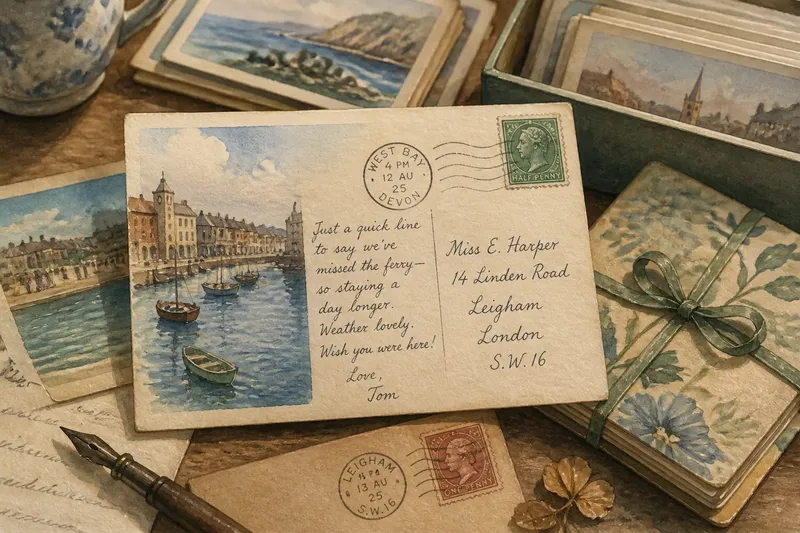
A picture postcard can be a message, a souvenir and a keepsake in the same small rectangle. Its role changes as it moves between sender, recipient and later owner; following those changes reveals why a card made for a brief exchange may remain meaningful long after its original journey.
What did the postcard do as a message?
The postcard’s first everyday task was practical: carry a short written note without the formality of a sealed letter. Its open format made the message visible to anyone handling it, while the picture on the other side could identify a place, offer a greeting or simply make the card appealing to send.
That openness shaped what people wrote. A postcard suited a few lines about arrival, weather, a change of plan or a greeting sent from somewhere else. Private or complicated news belonged more naturally in a letter; the card made brevity part of its character.
The image did not merely decorate the message. A view of a station, street, beach or landmark could do some of the explaining for the writer: “I am here” was often implicit in the scene. The sender added personal details that the printed view could not supply, turning a reproducible image into evidence of a particular visit.
Addressing and handling also gave the card a social life before it reached its recipient. A postmark and route through the postal system became part of the object’s visible record. The card could be read, passed around a household and kept on a mantel or tucked into a book, even if nobody had yet decided it was a keepsake.
When did a view become a souvenir?
A souvenir begins with a different purpose from a message. The traveller chooses an image to stand for a place or experience, then brings it home as a portable reminder. A postcard was convenient for this role because it could be bought, carried and sent without needing to be made specifically for one recipient.
The same card could serve both purposes. Someone might write a few lines on a seaside view and post it to a relative; another card from the same set might travel home unwritten. The first records a communication as well as a visit, while the second keeps the view without documenting a particular exchange.
Printed scenes also influence what a place is remembered as. A card might present a familiar landmark, a broad landscape or a busy street, selecting one view from the larger, less tidy experience of being there. Choosing and sending that image says something about what the traveller thought worth sharing, even when the caption is sparse.
Imagine a traveller buys a card showing a harbour, writes to a friend about missing the ferry and posts it before leaving town. The recipient later remembers both the harbour and the practical mishap; the card’s souvenir value has grown from a message that was personal, brief and tied to a specific moment.
How does a postcard become a keepsake?
A keepsake is defined less by what the card was made to do than by what someone continues to attach to it. The recipient may retain it because of the sender, the handwriting, the news it carried or the occasion surrounding its arrival. A card need not be rare or visually striking to become part of a family’s remembered past.
Handwriting can make the distinction especially clear. A printed view may be shared by many people, but the words, signature, address and marks of postal handling belong to one exchange. Even a short note can later identify relationships and habits that the image alone cannot reveal.
Some cards acquire meaning through repetition. A person may send a similar greeting each year, or relatives may keep cards from one particular journey. In that setting, the postcard becomes part of a pattern: its significance comes not just from one scene but from its place among recurring acts of contact.
Other cards are kept because they connect a person to a place they no longer visit, or to someone who has died. The original purpose may have been ordinary, but later circumstances change the object’s work. What once said “wish you were here” may come to stand for a relationship, a household or a period of life.
Why do collectors see more than a picture?
Collecting adds another layer without cancelling the earlier ones. A collector may be drawn to a subject, publisher, printing style, location or the evidence of use. One person values a crisp image; another prefers a card with a legible message and a clear postal route because those details make its journey easier to imagine.
Postcards can be considered as printed objects as well as personal documents. The image, caption, layout and printing choices reflect how a place or subject was presented to buyers. A set of cards may show changes in fashion or local appearance, though the printed view remains a selective representation rather than a complete account.
Condition and completeness can affect how a card is interpreted. A clean, unposted card may foreground its image and manufacture. A written card may offer more context, while a missing caption or damaged corner can make identification harder without removing all interest. Collectors make different choices because they are collecting different things: a subject, a visual style, a record of correspondence or some combination.
The market for cards can also encourage a shift in attention. Once an object is bought because it belongs to a category or set, its original message may become secondary. Yet the two roles can coexist: a card can be catalogued as an example of a printed view and still carry a note addressed to one particular person.
What questions help explain a postcard’s changing role?
Can a postcard be a souvenir if it was never sent?
Yes. A card bought and carried home can preserve a chosen view even without a written message or postal journey. Its connection to a place comes from the buyer’s selection and the circumstances of bringing it back.
Does handwriting make a postcard more personal?
Often, because it links the printed image to a particular sender and exchange. A blank card can still be personally meaningful, but handwriting supplies names, words and traces of a specific act of communication.
Why might someone collect ordinary postcards?
The appeal may lie in recurring subjects, local views, printing details or the everyday messages people chose to send. A collection can make familiar images and brief notes easier to compare, giving ordinary cards a shared context.
Can the same card change meaning over time?
Yes. A recipient may first treat it as a message, later keep it as a reminder of its sender, and eventually value it as part of a collection. The card stays materially the same while its place in someone’s memories changes.
How can you follow a card’s journey over a week?
A short, unhurried look at one postcard can make its changing uses easier to see. Choose a card already in your possession, whether it is written or blank; the aim is to notice its roles, not to assess its condition or make decisions about paper care.
- On the first day, record what is immediately visible. Note the image, caption, handwriting, address and postmark, if present. Keep description separate from interpretation: “a street with shops” is an observation; “a holiday scene” is a possible reading.
- On the second day, read the message as an exchange. Ask who appears to be writing to whom, what the note tells the recipient and what it leaves unsaid. If there is no writing, note that the card may have been kept, displayed or sent without a message you can see.
- On the third day, consider the view as a souvenir. Look at what the image includes and excludes, and ask why a traveller might choose it. A caption or place name can guide your reading, but the card does not reveal every reason behind the choice.
- On the fourth day, identify possible later meanings. Think about whether the card might be associated with a sender, a place, a family occasion or a group of related cards. Keep these as possibilities unless the card itself provides supporting clues.
- On the fifth day, compare it with another card, if one is available. Look for differences in subject, wording or how much personal information appears. A comparison can show how two cards with similar images served different purposes.
- On the sixth day, write a short account of its roles. Separate what the card was made to do, what its first user seems to have done with it and what it means to you now. Mark uncertain details rather than filling gaps with a confident story.
- On the seventh day, decide what context should travel with it. A brief note naming the people, place or circumstances you know can help a future reader understand why the card matters. If those details are unknown, recording that uncertainty is more useful than inventing a backstory.
This routine is useful because it distinguishes visible evidence from later interpretation. It also shows why a postcard’s meaning is not fixed by its printed picture: the message, the journey, the recipient’s memory and a collector’s interests can each add a different layer.
What changes when you keep the card?
Keeping a postcard extends its life beyond the moment it was sent or bought. It may remain a modest record of a visit, become a reminder of a person, or enter a collection where it sits alongside cards chosen for their images. None of those roles has to replace the others.
When you encounter a picture postcard, ask what it did at each point: what its maker offered, what its sender or buyer chose, what its recipient received and what later owners remember. That question keeps the card connected to human use, not just to the scene printed on its face.
The most revealing detail may be a line of handwriting, a place name or the fact that the card was left blank. A picture postcard can outlast its original errand because someone keeps finding another reason to look at it.