The Collection That Keeps Growing: Why a Theme Needs Edges
A collection theme with clear boundaries makes objects easier to compare, display and enjoy. Choose a scope that fits your interests and space.
A collection theme with clear boundaries is easier to understand than one that expands with every appealing find. A group of objects needs room to develop, but without a limit it can become a pile of unrelated purchases whose shared idea is hard to explain.
The answer is not to make every collection small or strict. It is to choose what belongs, what does not, and what might qualify only under particular conditions. Three approaches work well: collect one defined type, follow a subject across different types, or keep a broad theme with a few clear exclusions. Each suits a different appetite for variety.
Why does a collection need edges?
A boundary gives you a reason to compare one object with another. If you collect only tins from a particular kind of product, you can notice changes in shape, lettering and decoration. If you collect anything that catches your eye, those comparisons may be harder to see.
Edges also make decisions less tiring. At a charity shop, market or family clear-out, a simple rule helps you decide whether an object belongs before you bring it home. It can also make a shelf, drawer or display case feel deliberate: each item has a relationship to the others, rather than merely occupying space beside them.
A useful theme is not a subject label alone. “Kitchen objects” is a starting point, but it could include almost anything. “Hand-held kitchen tools made chiefly of wood” gives you something to apply, while still leaving room to learn what you like about the set.
Should you collect one defined type?
The narrow approach sets a firm boundary around an object type, maker, material or period of use. You might collect enamel mugs, matchboxes, wooden rulers, or paper labels from food packaging. The objects can differ in appearance, but they share a feature you can name.
This suits a collector who enjoys close looking and wants a coherent display. It can also suit someone with limited storage, because the rule naturally filters out tempting objects that do not fit. The trade-off is that the hunt may feel slower, especially if the chosen type is uncommon in the places you visit.
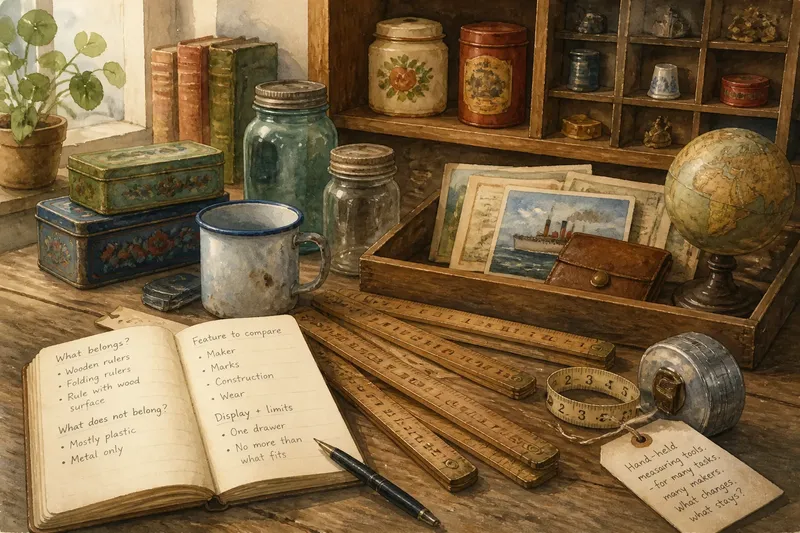
Define the category in ordinary language before you start. “Wooden rulers” might include folding rulers but exclude rulers made mostly of plastic, even if they have a wooden surface. You can leave room for exceptions, but record them as exceptions rather than quietly changing the definition whenever a new object appeals.
Say you already keep old measuring tools and are drawn to a metal tape measure at a jumble sale. If your boundary is wooden rulers, you leave it behind; if it interests you because it shows how measuring tools were made for different tasks, you might deliberately broaden the theme to hand-held measuring tools. The observable result is a changed rule you can explain, not a single impulse purchase that leaves the collection’s scope uncertain.
Would a subject-led collection suit you better?
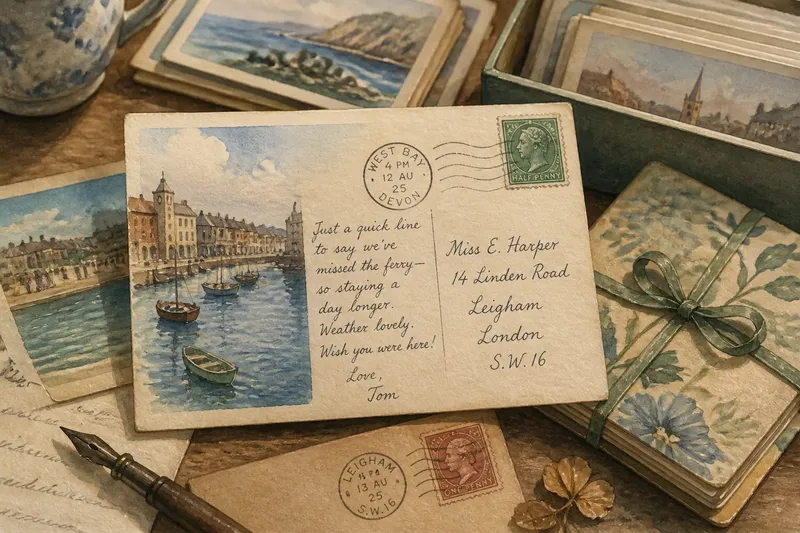
A subject-led collection follows an idea across several kinds of object. A theme such as travel might include luggage labels, ticket wallets, maps, postcards and small souvenirs. The objects need not match; their connection is the subject they help you examine.
This approach suits someone who likes variety or wants to show how a subject appears in everyday life. It gives you more ways to find relevant pieces, and it can make a display feel like a small, personal museum. Its weakness is that the subject can become so large that almost anything qualifies.
Set the connection, not just the topic. For a travel collection, you could include objects made to help someone prepare for a journey or remember one, while excluding general household goods that happen to depict a foreign place. That distinction keeps the collection from turning into a broad assortment of souvenirs and pictures.
A subject-led collection also benefits from a display plan. Group objects by what they did—prepare, guide, record or commemorate—rather than placing every item in one long row. Labels can be brief: a handwritten note on an index card might say what the object is and why it belongs, making the connection clear without requiring a long account.
When does a broad theme still work?
A broad theme can be the right choice if discovery matters more to you than a tightly uniform display. “Objects from the local high street” or “things used to keep food fresh” can bring together varied materials and forms. The theme works when the connection is specific enough that you can still reject a plausible-looking object.
Use a small set of exclusions to prevent drift. For example, a collection about keeping food fresh might include storage jars, wrapping materials and pantry tins, but exclude kitchen tools that prepare food rather than store it. These edges are not rules for everyone; they are a working definition of your own interest.
This option suits a collector who likes following side paths and does not mind revising the theme. It may be less suitable if you want a display that reads clearly at a glance or if you find it difficult to part with objects once they enter the home. In that case, a broad theme can still work, but use one shelf or one drawer as its physical boundary.
How can you choose the right boundary?
Start with the reason you enjoy the objects. Is it their material, their use, their graphic design, their local connection, or the small differences between examples? A boundary should make that interest easier to pursue, not turn collecting into a test of discipline.
Try these questions before settling on a scope:
- Can you say what belongs? Write one plain sentence describing an eligible object.
- Can you name what does not belong? Choose a likely near-match and state why it falls outside the theme.
- Can you compare the pieces? Identify a feature you want to notice across the collection, such as material, function, decoration or evidence of use.
- Does the scope suit your storage? Decide where the collection will live and what you will do when that space is full.
- Does finding objects remain enjoyable? Consider whether the boundary leaves enough room for curiosity without making every appealing find eligible.
If you can answer these questions without stretching the definitions, the boundary is probably useful. If every near-match becomes an exception, narrow the theme or write down a clearer connection. If the rule excludes the very objects that interest you, broaden it deliberately.
What questions help you refine a collection theme?
Can one object belong to more than one collection?
Yes. A tin might belong both to a collection of food containers and to a subject-led group about a particular place or product. Decide which connection matters for the display or record you are making, rather than assuming each object needs only one possible category.
Should you collect only objects in good condition?
That depends on what you want to understand. If surface design is the focus, heavy damage may obscure the feature you are comparing; if evidence of use matters, wear can be part of the reason the object belongs. Choose a condition rule that supports the theme, and avoid treating age or rarity as a substitute for interest.
What should you do when the theme stops feeling interesting?
Pause new additions and look through the group as a whole. You might discover that one part of it holds your attention more strongly, or that you would rather keep a small representative set than continue collecting. A theme can change, but deciding what the earlier objects mean to you is different from adding more simply because they are available.
How can you explain the boundary to someone else?
Use a short sentence and one example of an object that does not qualify. “I collect hand-held measuring tools, but not workshop equipment” is clearer than a broad label alone. If your explanation needs several exceptions, revisit the wording and make the central connection more precise.
How can you change the scope without losing its meaning?
Review the collection when it begins to feel crowded or repetitive, not every time a new object catches your eye. Lay the pieces out together, remove anything that no longer fits your stated connection, and note what the remaining objects have in common. A simple catalogue in a notebook or spreadsheet can record each object, its material, its use and the reason you kept it.
When you decide to broaden the theme, add one clear phrase to its definition and check the existing group against it. When you narrow it, choose what to keep based on the question you now want the collection to answer. You might set aside excluded objects for another collection, offer them to someone who wants them, or let them go; the important point is to avoid keeping every item by default.
A collection theme with edges should make looking more rewarding, not close off curiosity. Choose the narrow, subject-led or broad approach that matches how you notice objects, then keep the boundary visible in a sentence, a display or a record. That small act gives each addition a place—and gives you a clear reason to leave the next tempting object behind.